
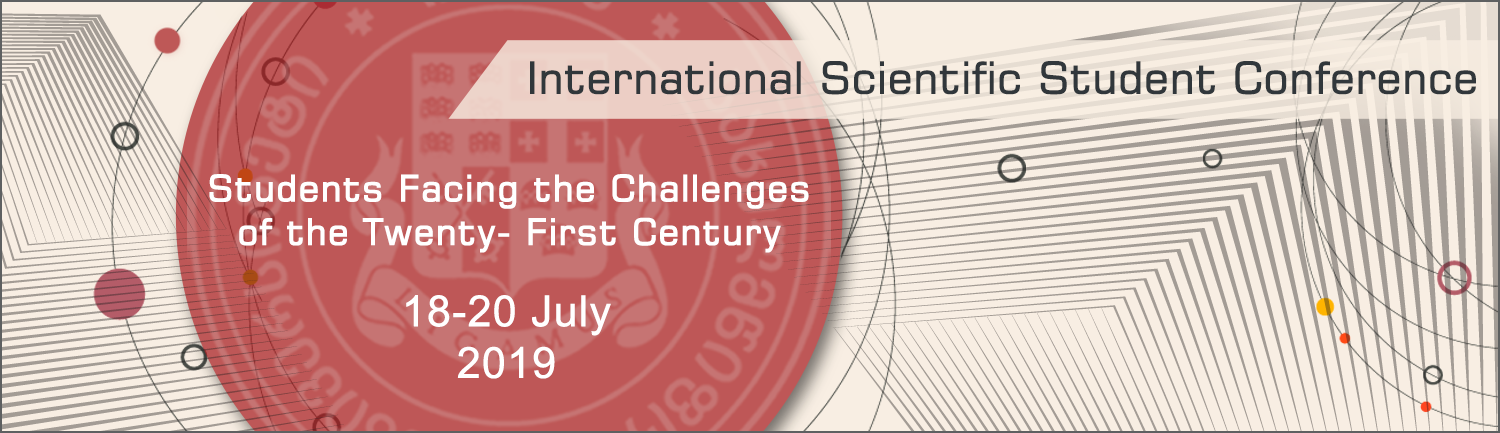
Students Facing the Challenges of the Twenty- First Century
Ilia State University, Georgia
18-20 July, 2019
Proposal submission deadline: 10 April, 2019
The twenty-first century has brought new challenges to the university education. In the last few years, most universities have witnessed the significant inner transformations in their education system. However, there still remains a serious challenge to the universities to meet the demands of the social community the product of which they represent.
At the turn of the 21st century, the major challenges face the university education system: economic globalization, knowledge-based economic growth, the information and communications revolution, global migration process, the national and transnational policy, – all these significant trends require a sufficient acquisition of competences and skills to ensure career success that students aim to achieve in 21st century.
The challenges of the twenty-first century lead to a wide range of competences of various fields, namely, specialized capabilities, social and intercultural competences, language competences- English languish acquisition along with other languages, and finally, the immediate knowledge of economic and political forces that affect the modern societies.
Accordingly, in the last two decades, the modern societies have witnessed the necessity of adopting a new teaching / learning model. There are a lot of relevant texts available that focus on the three leading issues- certain motivations for adopting a new learning and teaching model, the acquisition of specific competences and skills required to answer the challenges of the twenty- first century and the pedagogy of stimulation of these skills (Cynthia Luna Scott, 2015).
The special document approved by the UNESCO in 2015 introduces a list of competences and skills, intended to be developed in the educational process and thus adopting the appropriate pedagogy, that will promote students’ postgraduate advancement that come as a relevant response to the recent challenges of social and labor market.
The recent challenges include introducing new digital technologies in the learning process and setting a relevant academic condition for students and professors so that they can reach the target of applying new technologies together with the traditional models of teaching / learning. In addition, today, when there is a large access to any kind of unverified or verified information for students available in the shortest period of time, it still remains within the university commitments to promote critical thinking in students, to teach them how to use new technologies, how to evaluate and choose the relevant information for their professional advancement and then, how to use the knowledge in practice.
Correspondingly, the aim of the conference is identifying and discussing the recent reforms in the university education system in Central and Eastern Europe including the specific questions: how the students engage in reform initiatives and its implementation; how they evaluate the corresponding relationship between the universities and employment market; how the professional skills can be adopted within the learning process; how the students engage in starting and developing scientific and research projects; how they are equipped with the opportunities to participate in research projects with their professors that finally achieves the goal of acquiring a wide range of skills and competences, such as metacognitive and intercultural competences, team work, team partnership and leadership, initiatives and enterprise management knowledge, organization, curiosity and imagination, efficient oral and writing communication skills, information acquisition , critical thinking and decision-making skill, flexibility and adaptability, risk-taking and creativity (Wagner 2010).
Based on the above, the participant students can submit their proposal on the following colloquium topics:
In addition, the conference participants can offer other colloquium topic on the university education.
Communication languages: Georgian, French, English
Articles will be evaluated by the Scientific Committee (double anonymous evaluation). They will be published in the 7th edition of the CODFREURCOR journal Etudes interdisciplinaires en Sciences humaines (Tbilissi, Georgia)
Conditions of participation:
Proposal should be prepared and submitted as a word format. The font should be Times New Roman, size 12. It should include the following information:
Civil Status: (Mr/Mrs/Ms)
Student status: Bachelor, Master’s, PhD student
First Name:
Last Name:
University:
Postal Address:
Phone number:
E-mail address:
The title of the paper (max. 20 words)
Abstracts should be written in the language of communication and in English with keywords (max. 250 words)
All proposals should be submitted at colloqueetudiant@iliauni.edu.ge
Dates:
The Organisation Committee:
Megi Gaprindashvili- megi.gaprindashvili.1@iliauni.edu.ge
Elza Imnadze – elza.imnadze@iliauni.edu.ge
Salome Pantsulaia – salome.pantsulaia.1@iliauni.edu.ge
Nino Kharazishvili – ninakharaz@yahoo.fr
Mariam Kharebava – mariami.kharebava.1@iliauni.edu.ge
Salome Lapachishvili – salome.lapachishvili@iliauni.edu.ge
The Scientific Committee:
Voir ci-dessous le texte de l’Appel à communications en français
[wpai_display_imported_files_here]