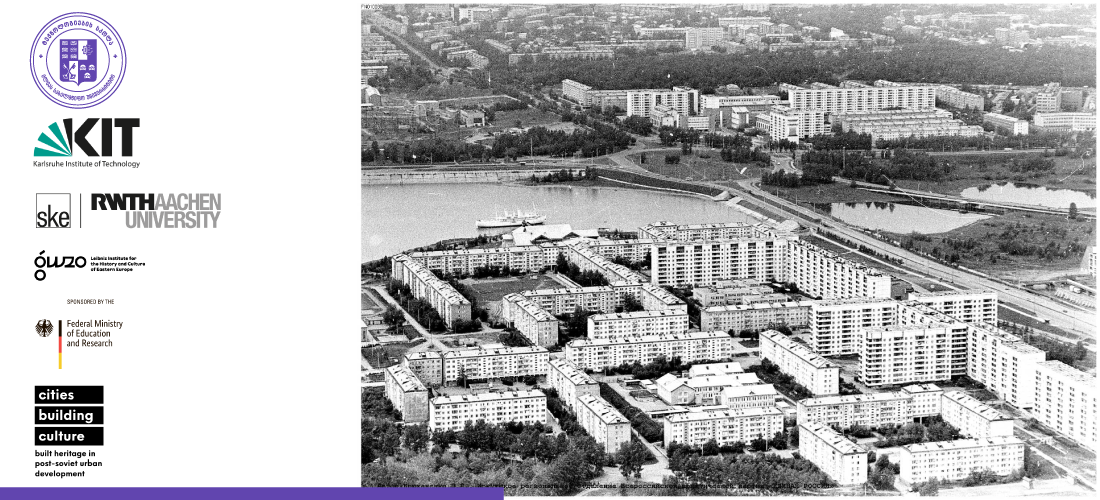
On September 28, at 6:00 pm, an exhibition titled “Residential Heritage: Soviet Morphotypes and Typologies” will open at Ilia State University, followed by a public lecture by Polina Gundarina (Georg August University of Göttingen)
Residential neighborhoods realized under Soviet power from 1917 to 1991 shape today’s urban space and everyday life in many cities in East-ern Europe and the South Caucasus, yet they also reflect the social ruptures and contradictions of the post-Soviet space.
Soviet planning was rigid and organized within the framework of political and ideological imperatives, as well as performed by the existing building technologies at the time. However, the planning era yielded a diverse range of urban layouts and architectural features, ranging from the avant-garde’s initial experimental projects combining private and communal spaces to the socialist cities of the industrialization period and onwards to the standardized microrayon plans – essentially, a city within a city.
The exhibition presents archival materials on Soviet morphotypes and typologies from Armenia, Belarus, Georgia, Kazakhstan, Latvia, Lithuania, Russia, Ukraine, and Uzbekistan.
Over the past 40 years, the spatial configuration of urban morphotypes and buildings has been transformed. The historical building stock provides an extensive housing resource for the future, yet it faces the twin threats of deformation and demolition. It is also crucial not to overlook the experiences accumulated by these countries themselves in dealing with Soviet heritage, its transformation, renewal, or adaptation.
This exhibition was developed as part of the collaborative research project cities. building.culture, in cooperation between Karlsruhe Institute of Technology (KIT), RWTH Aachen University, GWZO Leipzig, and their partners. The aim was to develop approaches to the sustainable management of built heritage in the post-Soviet space. The project constitutes an interdisciplinary dialogue at the intersection of cultural, historical, social, planning, and environmental sciences by looking at residential neighborhoods from the pre-socialist and socialist eras of the late nineteenth and twentieth centuries.
For more information: www.cities-building-culture.com
Polina Gundarina (Dr. des.) is a cultural historian. Her doctoral dissertation, Palaces for Workers: Soviet Leisure and Houses of Culture Before and After 1991, is forthcoming as a monograph next year, and she is currently a lecturer at Georg August University of Göttingen.
Join Zoom Meeting
https://iliauni-edu-ge.zoom.us/j/86837107930?pwd=GmYiNPipSpsCoKfJhr76bbZqHHNvCf.1
Meeting ID: 868 3710 7930
Passcode: 723994
Exhibition opening: 6:00 PM
Public lecture by Polina Gundarina: 7:00 PM
The exhibition will run from September 28 to October 3
Address: Foyer of Building G, Ilia State University, 1-3 G. Tsereteli Exit
2026